Clean dry air (CDA) for semiconductor manufacturing
Clean dry air (CDA) is compressed air that has been dried and filtered to such an extent that moisture, oil and particles have been virtually removed. In semiconductor manufacturing, that is not a luxury: even minimal deviations can already affect yield, equipment and cleanroom conditions. That is why the requirements in wafer fabs are much stricter than for standard plant air, often with ISO 8573-1 Class 0 as the starting point, supplemented by an appropriate pressure dew point and sometimes additional limits for molecular contamination. The core question, then, is not only which class is required, but also where the air is used, how the CDA chain is set up and how you demonstrably monitor stable quality. For broader contamination-control context, see why air quality matters.
Why ordinary compressed air in wafer fabs creates too much risk
Ordinary compressed air is intended for general utility use. In a wafer fab, that same air may be unsuitable, because even traces of moisture, oil or particles can already disrupt the process. Moisture increases the risk of condensation and oxidation, oil can contaminate sensitive surfaces and components, and particle deposition in wafer production can affect critical process steps and electrical functions. That contamination affects not only product quality and yield, but also cleanroom conditions and vulnerable machine components. You should therefore treat CDA as a process-critical utility, not as a standard compressed air supply. For practical measures to minimise this risk, see reducing particle deposition in wafer production.
Which basic specifications CDA must meet for semiconductor manufacturing
ISO 8573-1 is the usual basis for specifying requirements for particles, water and oil. For semiconductor-grade CDA, Class 0 is often taken as the starting point, but that designation is only useful if clear limit values have been set for each contamination category. The pressure dew point indicates how much moisture is still present in the air and how much condensation risk remains; depending on the process, targets often lie around -40 °C to -70 °C, where dry process air also increases the need for ESD control in cleanrooms. For RH control and dew point fundamentals, see temperature and humidity in cleanrooms. Cleanroom acceptance and air cleanliness are tied to ISO classes; see ISO 14644-1 standards and classification. The right specification is ultimately determined by process sensitivity and point of use, not only by central generation.
When ISO 8573 does not say enough about your process
| Additional concern | Examples | Appropriate control |
|---|---|---|
| Molecular contamination | Acidic or basic gases, CO/CO2, sulphur and nitrogen compounds | Gas analysis at critical measurement points |
| Organic traces | Total hydrocarbons, VOCs, oil residues | THC measurement and filter performance checks |
| Process- or fab-specific limits | SEMI F21 or internal specifications alongside ISO 8573 | Particle measurement, dew point measurement and verification at point of use |
How a reliable CDA chain is built
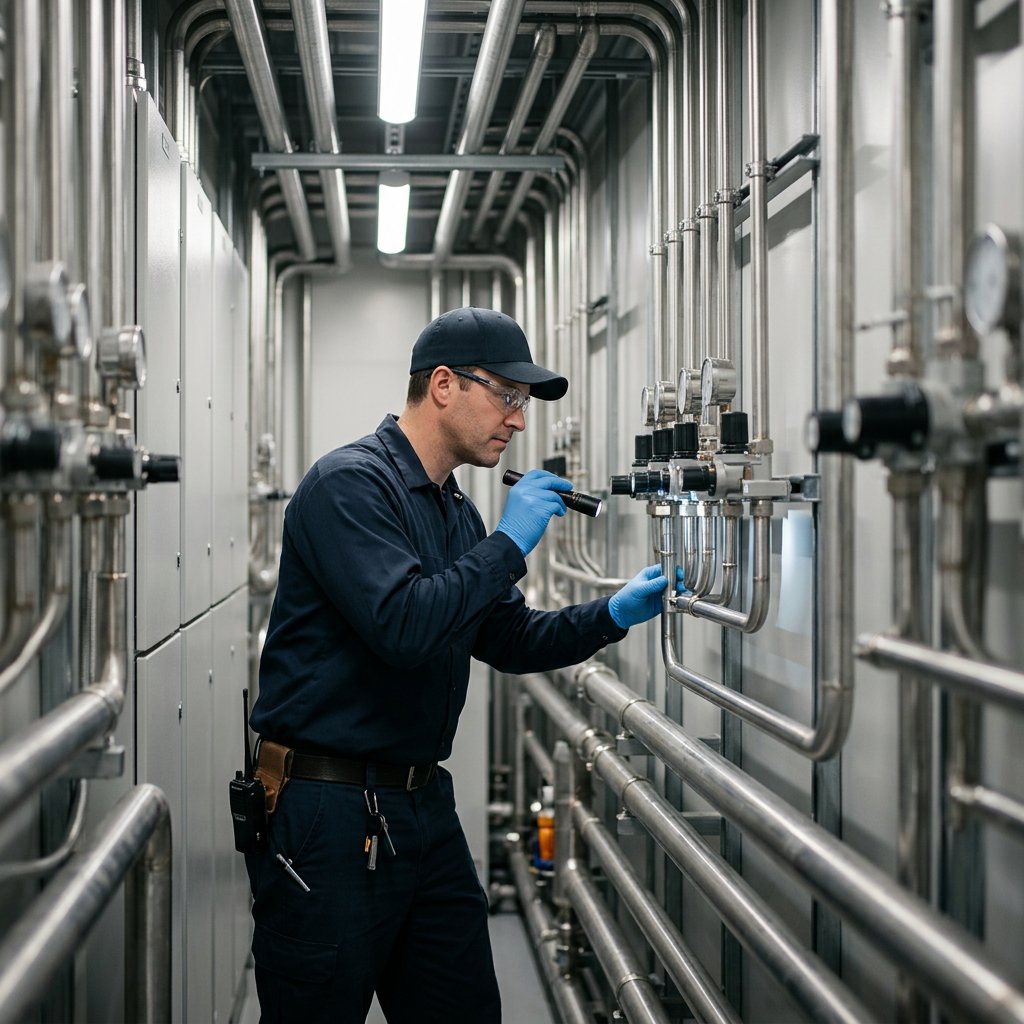
A robust CDA chain logically starts with low-oil or oil-free compression, so that a major source of contamination is reduced straight away. This is usually followed by pre-filtration, deep drying with a desiccant dryer, downstream filters and, on the clean side, final fine or membrane filtration. That sequence is essential: it protects the dryer, captures dust from the desiccant and prevents contamination from migrating towards the cleanroom. Energy consumption and operating costs matter, but only after the required purity and stability can be demonstrably achieved.
How to keep CDA quality stable during operation
- Measure the dew point and relevant contamination indicators periodically, both centrally and at critical points of use.
- Replace filters and desiccant according to condition and specification.
- Check drains, differential pressure and filter integrity.
- Treat a rising dew point or unexpected contamination as a sign of degradation in the drying bed, filtration or due to upstream oil carry-over.
For a structured setup of monitoring critical parameters, see cleanroom monitoring plan.
How CSI translates air quality into practical cleanrooms for semiconductor manufacturing
CSI has a project portfolio in high-tech, including semiconductor projects, and works with its own modular wall and ceiling systems. As a result, air quality in projects is not viewed separately from space, process and utilities. CDA requirements affect zoning, pressure hierarchy, material choices, routing around equipment and maintenance access at the cleanroom interface. CSI does not supply compressors or dryers, but designs and realises the cleanroom in such a way that the required air quality remains practical to support. Early alignment with utility partners and commissioning or validation parties helps to limit failure costs and operational risk.
Which CDA specifications you should define in advance
- Specify CDA per process or point of use, not as one generic requirement for the entire fab.
- At a minimum, define: ISO 8573-1 class, pressure dew point, additional contaminant limits and where these are measured.
- Describe the required chain of compression, drying and filtration so that the requested quality is technically achievable.
- Agree before commissioning how acceptance tests and periodic re-inspections will be carried out and reported.