


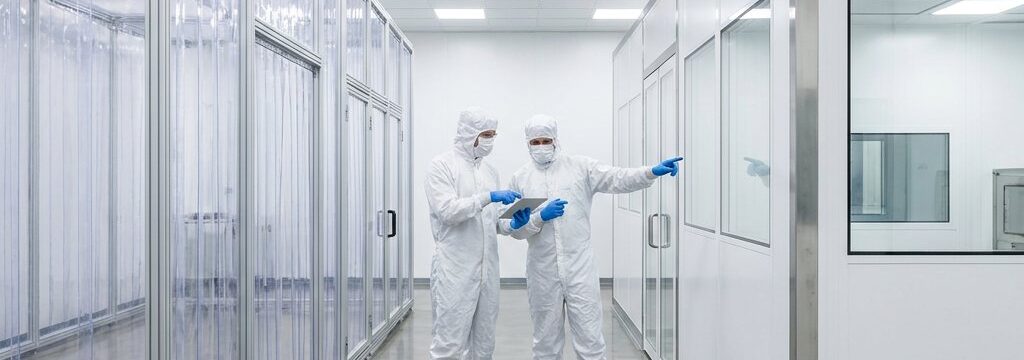
Softwall vs hardwall cleanroom

Are you unsure whether to choose a softwall or hardwall cleanroom? In short, softwall is usually better suited to rapid installation, lower upfront costs and changing layouts. Hardwall is more often the right choice if you need greater structural stability, better cleanability and tighter control of pressure and contamination. The best solution depends not only on the wall type, but on your entire process, desired ISO classification, routing, utilities and any GMP requirements. Your choice of cleanroom wall, floor and ceiling materials also plays a role.
Table of contents
- 1The main difference is in construction and control
- 2When is a softwall cleanroom a better fit?
- 2.1Key strengths
- 2.2Less suitable for
- 2.3Typical uses
- 3When is a hardwall cleanroom a better fit?
- 3.1Key strengths
- 3.2Less suitable for
- 3.3Typical uses
- 4How do you make the right choice for your process?
- 4.1Classification and compliance
- 4.2Planning and total cost of ownership
- 4.3Growth and adaptability
- Show more...
Key takeaways
- Softwall: rapid installation, lower upfront cost and high layout flexibility.
- Hardwall: greater structural stability, tighter sealing and better cleanability.
- The right choice depends on ISO/GMP class, process risk, airflow/pressure control, routing and materials.
- Softwall suits pilots, temporary capacity and changing layouts; hardwall for long-term, critical environments.
- Define a URS early and assess total cost of ownership, lead time, growth and adaptability.
The main difference is in construction and control
A softwall cleanroom consists of a modular frame with flexible PVC or vinyl curtains. A hardwall cleanroom uses rigid, smooth panels, for example PETg, HPL, glass or other non-porous materials, installed in a modular support structure. That structural difference has a major impact in practice. Softwall is easier to adapt and quicker to build. Hardwall usually provides a more stable envelope, better sealing and surfaces that can be cleaned more consistently. In addition, the rigid construction makes integrations such as a walkable cleanroom ceiling possible when inspection or service access above the ceiling is required. Whether a cleanroom truly complies with ISO 14644-1 or, where applicable, GMP is ultimately determined by the overall design, the air handling and the validation.
When is a softwall cleanroom a better fit?
Key strengths
Softwall cleanrooms are particularly attractive when speed, flexibility and budget carry significant weight. They can often be installed quickly, are relatively easy to expand and are practical for temporary, growing or pilot environments. Softwall is also often a logical choice if existing machines or a changing product set-up are key considerations, or if you are considering building a cleanroom in an existing building.
Less suitable for
The downside is that flexible curtains are less robust and generally seal less tightly than hard panels. As a result, softwall is usually less suitable for critical pressure cascades, heavy traffic or processes with very high requirements for leak-tightness and cleanability.
Typical uses
In practice, softwall is often used for assembly, inspection, packaging or pilot production, especially when the cleanroom may still need to change, expand or be relocated later.
When is a hardwall cleanroom a better fit?
Key strengths
Hardwall cleanrooms are intended for long-term use and a higher level of process control. The rigid, smooth walls are easier to clean and usually support a more stable controlled environment. As a result, hardwall is often better suited to applications where pressure differentials, material selection, fixed technical integrations and documented control are important.
Less suitable for
On the other hand, hardwall generally requires more preparation, a higher initial investment and less straightforward reconfiguration. If your process is still changing significantly or the room may need to be relocated later, that needs to be taken into account early in the design.
Typical uses
Hardwall is often chosen for pharmaceuticals, medical technology, high-tech manufacturing, laboratories and other environments where continuity, cleaning regime and structural stability matter more than rapid relocation.
How do you make the right choice for your process?
Classification and compliance
The more critical your process, the more important factors such as leak-tightness, finish, pressure regime and cleaning protocol become. It is also important to determine your required level — see ISO 14644-1 cleanroom classification. For stricter ISO requirements, validation and any GMP applications, hardwall is often the most logical starting point.
Planning and total cost of ownership
If you are comparing the options, start with what does it cost to build a cleanroom? Softwall often reduces the upfront cost. Lead times are generally shorter, while hardwall usually requires more investment at the outset but can be more favourable in the long term if the room is used intensively and must perform consistently for years. If timing is critical, also consider how long does it take to build a cleanroom?
Growth and adaptability
If you expect expansion, relocation or frequent layout changes, modular flexibility is essential. In that case, softwall often has an advantage. With a fixed production set-up, hardwall offers more stability, durability and technical integration options. Explore the advantages of modular cleanroom systems.
To steer your design choices from the outset, consider drafting a cleanroom URS that captures process, classification and layout requirements.
Would you like to turn this comparison into a concrete design? Cleanroom Systems International B.V., operating from Drunen, supports organisations with modular, turnkey cleanrooms and a single point of contact from design and engineering through to construction, validation coordination and maintenance.
Frequently asked questions
What are the two most commonly used types of modular cleanrooms?
In modular cleanroom projects, softwall and hardwall are the best-known wall concepts. The choice is usually between flexibility and speed on the one hand, and structural control and durability on the other.
What are cleanroom walls usually made of?
Softwall usually uses PVC or vinyl curtains. Hardwall uses rigid, non-porous panels such as PETg, HPL, glass or other smooth materials, depending on classification, cleaning regime and sector requirements.
Which option is easiest to clean?
As a rule, hardwall is easier to clean because rigid panels are smoother and more dimensionally stable than flexible curtains. That supports hygiene protocols and reduces the risk of contamination in hard-to-reach areas.
Is there an intermediate option?
Yes, in some projects a rigidwall solution can be an interesting middle ground between flexibility and stability. Even so, the choice still mainly depends on process risk, classification, desired service life and future adaptability.
Related articles
Cleanroom energy consumption
The energy consumption of a cl…
ISO 14644-2 Cleanroom Validation
Cleanroom validation is the do…
Cleanroom training voor operators
In een cleanroom is de mens ze…
