


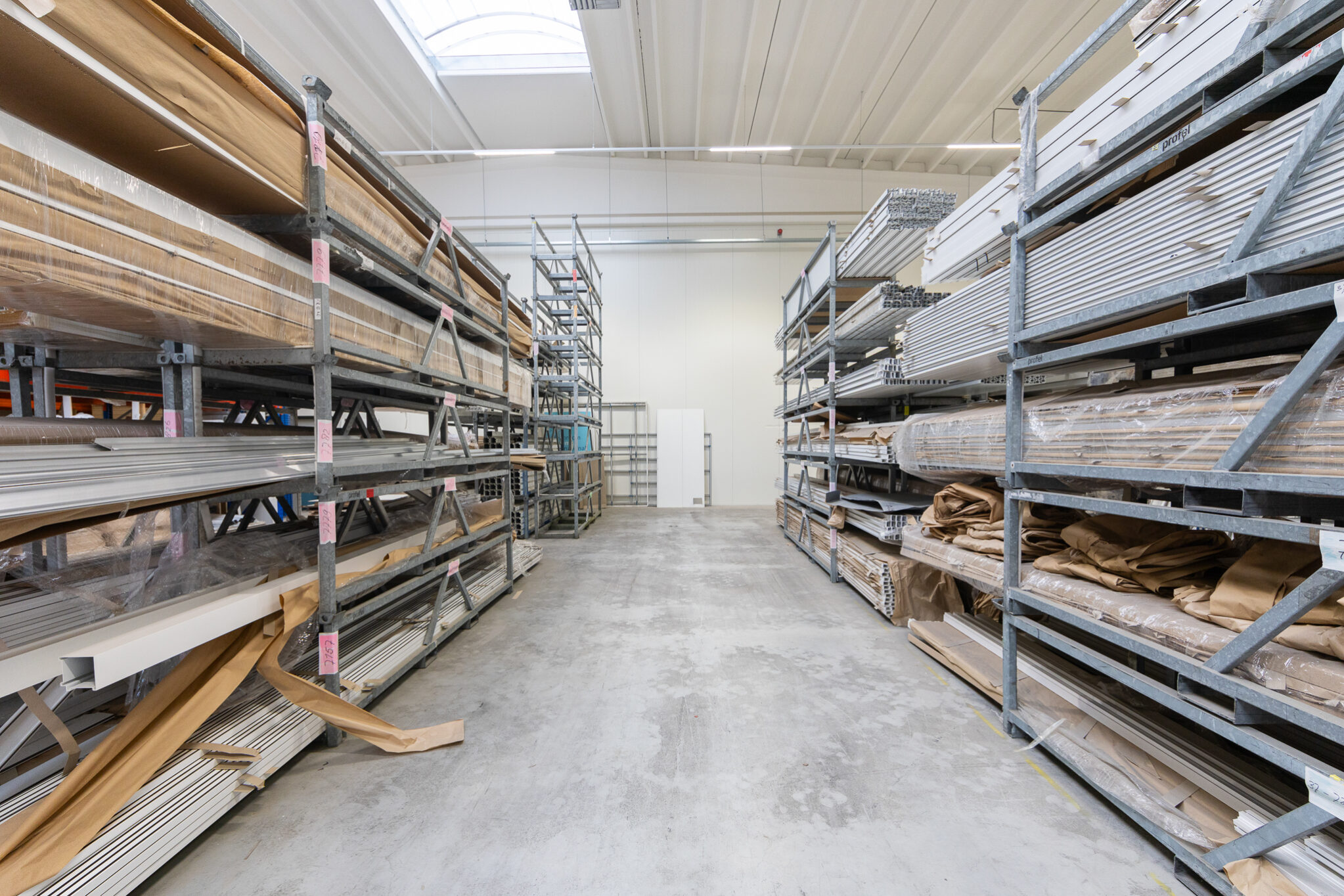
Materials for cleanroom walls

For cleanroom walls, not only the appearance matters, but above all the performance under controlled conditions. A suitable wall material must be smooth, easy to clean, moisture-resistant, low in particle formation, and, where necessary, chemically resistant. In addition, it must comply with the required ISO class, cleaning protocol, pressure zones, and any GMP requirements. The right choice reduces the contamination risk, supports stable classification, and makes maintenance and future adjustments easier. Are you considering a softwall or hardwall cleanroom? The wall system also determines the material options.
Table of Contents
- 1What requirements does a cleanroom place on wall materials?
- 2Common materials for cleanroom walls
- 2.1Coated steel panels
- 2.1.1When this material is often the best choice
- 2.2Stainless steel
- 2.3HPL and similar hardboard materials
- 2.4Glass as an integrated component
- 3Why modular cleanroom walls are often preferred
- 4The choice of material is related to classification and use
- 5Cleaning, maintenance and lifespan
- Show more...
Key takeaways
- Choose wall materials with a smooth, closed surface, low particle emissions and chemical resistance.
- Decide on material selection based on ISO 14644-1/GMP, cleaning protocol, pressure hierarchy and process risk.
- Coated steel offers efficient, modular construction; stainless steel is suitable for intensive disinfection/chemical stress.
- Modular systems accelerate construction, simplify customization, and support circular reuse.
- Detail the connections (floors, ceilings, doors/windows, penetrations) for airtightness and good cleaning ability.
What requirements does a cleanroom place on wall materials?
Cleanroom walls must be flat, sealed and as smooth as possible, so that dust, dirt and microorganisms cannot accumulate. Surfaces must be resistant to frequent cleaning and disinfection without damage, discoloration or particle release. In more stringent environments, airtightness, flush finishing and the quality of connections to doors, windows, ceilings and ducts also play a major role. The material is therefore not only an aesthetic finish, but a functional component of the entire cleanroom environment. This includes components such as a material gate and pass box in cleanrooms, which influence the material and finishing choices around the door openings.
Common materials for cleanroom walls
Coated steel panels
Coated steel panels are widely used in a modular cleanroom. They offer a smooth and closed surface, are dimensionally stable and can be easily integrated with ceilings, frames and technical equipment. For many high-tech, medical and industrial applications, this is a strong choice because the system is quick to assemble and allows for consistent finishing.
When this material is often the best choice
Coated steel is particularly interesting when you are looking for a robust wall structure, short build time, and later expansion capabilities. Within a modular system, panels can often be adjusted, moved, or replaced without having to rebuild the entire cleanroom.
Stainless steel
Stainless steel is chosen primarily in areas with high hygiene requirements, intensive disinfection, or heavier chemical exposure. The material is strong, corrosion-resistant, and easy to clean. Therefore, it is suitable for applications where wet cleaning or a heavier cleaning regime is required. However, stainless steel requires meticulous detailing so that connections and finishes maintain the same hygienic quality as the material itself.
HPL and similar hardboard materials
HPL and similar sheet materials may be suitable in less critical zones or supporting spaces, provided that the finish is sealed and easily cleaned. Suitability depends on classification, usage intensity, and cleaning method. In more critical cleanrooms, higher air density systems are often chosen for improved integration capabilities and more impact resistance.
Glass as an integrated component
Glass is usually not a primary wall material, but is an important component of cleanroom walls. Flush-mounted visible panels support process control and overview without additional openings in the space. In addition, the connection to the wall system is particularly crucial for cleanliness and airtightness.
Why modular cleanroom walls are often preferred
In new construction, expansion, renovation, or the creation of a cleanroom in an existing building, modular systems are often the most future-proof solution; read more about the benefits of modular cleanroom systems. They enable rapid construction, support a clean finish, and can be designed around the required classification, logistical routing, and technical integrations. For organizations that want to expand, reorganize, or relocate later, the use of demountable panels is particularly valuable. A good modular system reduces waste, shortens customization time, and supports circular reuse of parts.
At Cleanroom Systems International, we combine that approach with an integrated Design - Engineer - Build - Care workflow. This ensures that material selection, detailing, assembly, and maintenance are coordinated from the design phase, with minimal disruption to the existing operation as a starting point.
The choice of material is related to classification and use
The best material for cleanroom walls varies per project. ISO 14644-1 specifies the required air purity, but the practical choice also depends on the process, cleaning frequency, pressure hierarchy, and the required standard frameworks. A pharmaceutical space requires something different than a high-tech assembly environment or a food-related laboratory space. Therefore, not only the panel itself is considered, but also the connections with floors, ceilings, doors, windows, and utilities. It is in these details that the weak points for contamination, leakage, or difficult-to-clean areas most often arise. Are you unsure about the correct standard? View which ISO or GMP class your cleanroom requires for context regarding material requirements.
Cleaning, maintenance and lifespan
Wall material performs well only if it is easy to clean in practice. Therefore, pay attention to resistance to disinfectants, scratch sensitivity, recoverability, and resistance to impact from carts or internal transport. Smooth and closed surfaces shorten cleaning time and make it easier to follow established cleaning guidelines for cleanrooms. In environments that change frequently, it is also important how easily panels can be replaced or moved without long downtime.
Do you want to determine which wall material suits your ISO class, cleaning regime, and expansion plans? Cleanroom Systems International integrates material selection, system design, and maintenance into a seamless whole.
Frequently asked questions
What properties are most important for cleanroom walls?
The main characteristics are a smooth and closed surface, low particle emissions, good cleaning ability, chemical resistance, airtight connection, and sufficient mechanical strength. In regulated environments, flush detailing and suitability for the cleaning protocol are also important factors.
Are his standard system walls suitable for a cleanroom?
That depends on the classification and application, but standard interior walls often do not meet the requirements of critical cleanroom zones. Knots, porous surfaces, and limited air tightness can pose a risk to cleanliness and contamination control.
When should you choose stainless steel instead of coated steel?
Stainless steel is logical when the space is intensively being disinfected, requires a higher chemical load, or requires extra hygienic robustness. However, coated steel is a very efficient and technically robust solution in many projects, especially within modular systems.
How do you clean cleanroom walls?
Cleanroom walls are cleaned according to a fixed protocol using appropriate tools, cloths and work sequence. The chosen material must be able to withstand this method without wear, discoloration or particle formation. Therefore, material selection and cleaning plan should be considered from the very beginning.
Can modular cleanroom walls be adapted later?
Yes, that is an important advantage of modular construction. Depending on the configuration, panels, windows, doors, and technical integrations can be modified or expanded later. This makes the cleanroom better prepared for process growth and future adjustments.
Related articles
Cleanroom interlock: operation, types and design considerations
A cleanroom interlock prevents…
Material Transfer in Aseptic Cleanrooms
Material and equipment transfe…
Cleanroom smoke study
A smoke study makes airflow vi…
