


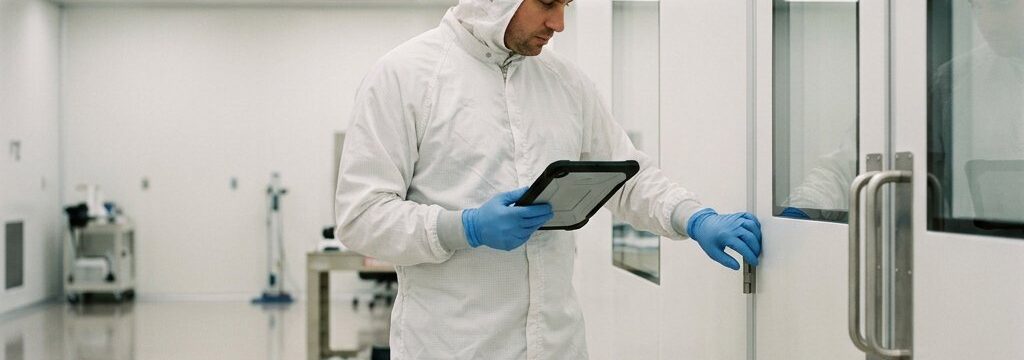
DQ, IQ, OQ and PQ for cleanrooms

DQ, IQ, OQ and PQ together form the evidence that a cleanroom is suitable for the intended process from design through to day-to-day use. This is about more than a one-off ISO classification test or a final certificate: design choices, installation, technical operation and performance in use must also be demonstrably correct. The scope required depends on the user requirement specification (URS), the required ISO or GMP class, the process risk and changes during the cleanroom's life cycle.
Table of Contents
- 1How the qualification cycle makes a cleanroom demonstrably fit for purpose
- 2DQ: assessing the design against use, risks and regulations
- 3IQ: verifying that the cleanroom has been built and connected correctly
- 4OQ: proving that systems operate within agreed limits
- 5PQ: confirming that the cleanroom performs stably in practice
- 6Which tests and measurement points belong to which qualification stage?
- 7Documentation, deviations and requalification: how to stay in control of compliance
- 8Common mistakes that unnecessarily delay DQ/IQ/OQ/PQ
- Show more...
Key takeaways
- DQ, IQ, OQ and PQ together form the full qualification chain from design to routine use.
- DQ assesses the design against the URS, risks and standards and sets clear acceptance criteria.
- IQ confirms complete, correct and traceable installation before OQ starts.
- OQ proves functions, controls and alarms; PQ confirms stable performance under representative conditions.
- A complete dossier plus monitoring and change control ensure continued compliance and guide requalification.
How the qualification cycle makes a cleanroom demonstrably fit for purpose
Cleanroom qualification is an ongoing process that, following a cleanroom validation step-by-step approach, starts with the user and process requirements and only ends when release, monitoring and periodic reassessment are properly organised. In that cycle, Design Qualification (DQ), Installation Qualification (IQ), Operational Qualification (OQ) and Performance Qualification (PQ) each answer a different risk question: has the right room been designed, has it been realised correctly, does it operate within agreed limits and does it continue to perform stably in practice?
For cleanrooms, this revolves around control points such as particle levels, airflow, pressure hierarchy, temperature and relative humidity. Standards such as ISO 14644-1 cleanroom classification and, where applicable, GMP provide direction for the required supporting evidence, but the actual implementation must always align with the intended use of the room, the process load and the criticality of the product or research.
DQ: assessing the design against use, risks and regulations
DQ confirms that the cleanroom design matches the URS, the process and the required classification before construction and release proceed further; that preparation starts with creating a cleanroom URS. In this phase, the layout, material and personnel flows, the HVAC concept, pressure cascade, finishes, utilities and relevant supplier documentation are assessed, among other things. The aim is to identify design deviations early so that problems are prevented later in IQ, OQ or PQ. The outcome is therefore not just an approval, but a substantiated dossier with acceptance criteria, findings, deviations and recorded actions.
IQ: verifying that the cleanroom has been built and connected correctly
IQ records that the completed cleanroom corresponds to the approved design and the as-built state. It checks whether components are correctly identified, whether utilities and connections have been installed correctly, whether instrumentation and control systems are in place, whether filters are in the correct position and whether certificates, calibration status and operating documentation are available. Test stages such as FAT and SAT at cleanroom handover and commissioning or start-up show that something works; IQ provides the formal, traceable confirmation that everything has been installed completely and correctly. Outstanding installation deviations must first have been assessed and closed out before OQ can usefully start.
OQ: proving that systems operate within agreed limits
OQ demonstrates that the cleanroom and the technical systems function as designed, within predefined operating limits. The focus is on the operation of HVAC and controls, alarms and interlocks, and on environmental conditions such as pressure differentials, temperature and humidity. This looks not only at normal settings but, where relevant, also at boundary conditions or challenge situations. The result of OQ is objective test data and reporting that demonstrably shows that the operational control of the cleanroom is technically sound.
PQ: confirming that the cleanroom performs stably in practice
PQ proves that the cleanroom continues to meet the requirements for process, occupancy and product protection under representative conditions of use. The emphasis is on consistent performance over time, for example during normal production, representative loading or simulations close to the actual process. This makes PQ clearly different from OQ: OQ demonstrates functional operation, while PQ confirms that this operation also remains stable enough in day-to-day practice. PQ therefore provides an important basis for release for use, a well-defined cleanroom monitoring plan and periodic confirmation of performance.
Which tests and measurement points belong to which qualification stage?
The mapping below is indicative: the exact set follows from the URS, the required class and the process risk. The same test may serve a different purpose in each phase, which means classification or certification tests form only part of the total DQ/IQ/OQ/PQ evidence package.
| Test or measurement point | Usually relevant in | Purpose within qualification | Typical output |
|---|---|---|---|
| Particle measurement and classification | OQ and/or PQ | Demonstrating that the room meets the agreed cleanroom class under defined conditions | Measurement report, raw data, measurement locations, calibration references and deviations |
| Airflow visualisation | DQ, OQ, PQ | Substantiating design choices for airflow and later confirming that air patterns remain suitable in use | Smoke study report, visual material, observations and acceptance assessment |
| HEPA filter integrity | IQ and OQ | Verifying that filters are correctly installed and show no leaks within the test scope | Filter test report, filter identification, test settings and deviation log |
| Pressure differential | IQ, OQ, PQ | In IQ, confirming correct installation; in OQ, testing controls and alarms; in PQ, monitoring a stable pressure hierarchy during use | Measured values, trend data, alarm checks and calibration data |
| Temperature and relative humidity | OQ and PQ | Demonstrating that environmental conditions remain within agreed limits under normal conditions and relevant boundary loads | Data logs, trend logs, setpoints and deviation handling |
| Recovery, or recovery time | OQ, sometimes PQ | Assessing how quickly the room returns to the required condition after a disturbance | Time series, test conditions, acceptance criteria and reporting |
| Microbiological monitoring where relevant | PQ and ongoing monitoring | Confirming that performance in use matches the hygiene and process risks of the environment | Sample results, trend analysis, locations and deviation log |
Documentation, deviations and requalification: how to stay in control of compliance
A complete qualification dossier contains more than final reports alone. This includes approved protocols, raw measurement data, calibration certificates, deviation records, change control, CAPA and formal releases for each phase. Requalification may be necessary after changes to the layout, HVAC, utilities, filters, software or process load, but also in response to relevant trends, malfunctions or audit findings. Initial qualification must therefore connect with continued performance; in line with the ISO 14644-2 validation requirements, periodic monitoring and trend analysis show whether the cleanroom remains in control. In new build, expansion, retrofit and maintenance, an early link between design, engineering and qualification prevents a great deal of rework later in the project.
Common mistakes that unnecessarily delay DQ/IQ/OQ/PQ
- Starting qualification too late. If the URS, design choices and acceptance criteria only come together late in the process, this creates discussion, extra tests and avoidable corrections.
- Confusing certification with full qualification. A successful classification test does not automatically mean that design review, installation traceability and performance in use have been sufficiently evidenced.
- Carrying out OQ and PQ under non-representative conditions. Tests have little value if occupancy, process load or usage routines do not resemble the actual situation.
- Underestimating documentation. Missing calibration history, weak deviation handling and insufficient version control of protocols and reports directly delay release.
Frequently asked questions
Related articles
Cleanroom interlock: operation, types and design considerations
A cleanroom interlock prevents…
Material Transfer in Aseptic Cleanrooms
Material and equipment transfe…
Cleanroom smoke study
A smoke study makes airflow vi…
