


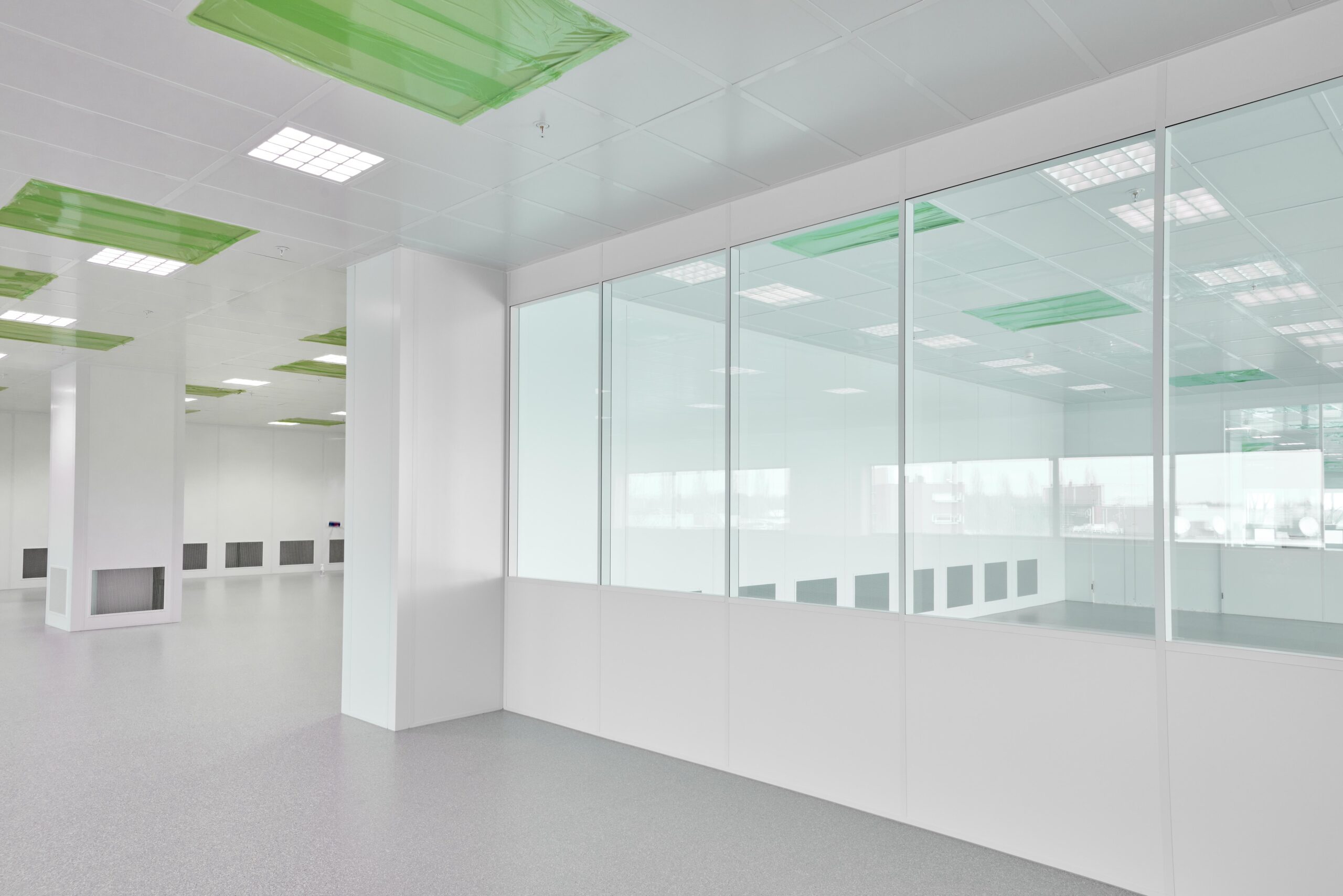
ISO 14644-1: explanation of cleanroom classification

ISO 14644-1 is the basic standard for classifying air purity in cleanrooms, clean zones, and certain separation devices. The standard does not specify what a cleanroom should look like, but rather how air quality is classified based on the concentration of particles in the air. This underscores why air quality matters when designing controlled environments. For organizations in pharma, medtech, high tech, and food, this is essential: the correct classification helps you design a controlled environment that fits the process, without unnecessary over- or under-specifications.
Table of Contents
Key takeaways
- ISO 14644-1 classifies air purity based on particle concentrations (0.1–5 µm).
- Classification is done using LSAPC measurements at predetermined measurement points.
- The standard does not cover microbiology/chemistry and >5 µm; M-descriptor for macro particles.
- Translate the class to design: air handling, filtration, routing, pressure hierarchy, and measurement strategy.
- Choose an appropriate class to send costs and lead time without over- or under-specifying.
What ISO 14644-1 actually means in practice
The core of ISO 14644-1 is simple: a cleanroom is given an ISO class based on the number of airborne particles per cubic meter of air at fixed particle sizes. The standard looks at threshold particle sizes of 0.1 µm to 5 µm. Based on these measurement values, it is determined whether a space meets the intended classification.
The standard applies to cleanrooms, clean zones, and certain separate systems as defined within the ISO 14644 series. As such, it forms a technical starting point for the design, qualification, and performance control of controlled environments. In projects, the standard is especially important because it objectively determines the air purity required for a product, process, or research application. This is also evident in the ISO 6 cleanroom project at High Tech Campus Eindhoven, where a specific class is central.
How the classification is determined
ISO 14644-1 bases its classification on measurements using light scattering particle counters, also known as LSAPC. Measurements are made at predetermined sample locations in the room. This means that not only the target class is relevant, but also the spatial layout, the air flow concept, and the chosen measurement strategy. In practice, this means that design and measurement must be aligned: measurement points, usage conditions, and acceptance criteria must be clearly defined beforehand.
The limits of the norm
ISO 14644-1 is deliberately specific. The standard does not classify particles smaller than 0.1 µm and does not use the standard classification for larger macroparticles above 5 µm. For larger particles, an M descriptor can be applied. Furthermore, the standard says nothing about the chemical, physical, radiological or microbiological nature of the particles found. An ISO class alone is therefore not the same as full process or GMP compliance.
What the standard does and does not cover
For many project teams, this is the most important distinction:
| Subject | Well regulated in ISO 14644-1 | Not intended for |
|---|---|---|
| Classification | Classification of air purity based on particle concentration | Assessment of microbiological or chemical contamination |
| Measurement base | Measurements using light scattering particle counters at designated locations | Complete process validation or interpretation of GMP requirements |
| Particle range | Threshold particle sizes from 0.1 µm to 5 µm | Ultra-fine particles below 0.1 µm as standard classification |
Why ISO 14644-1 is important for design and renovation
Anyone who builds, expands, or adapts a cleanroom must translate the standard into concrete design choices. This is where most of the added value often comes from. A correct interpretation of ISO 14644-1 helps to align air handling, filtration, routing, pressure hierarchy, cleanroom cubicles, and space layout with the actual risk of the process. The choice of a walkable ceiling can also influence airflow and the achievement of the desired class. Do you need to determine the class for your application? Read more about choosing the correct ISO or GMP class. If you work in an existing building and want to know what is feasible, we assess design choices against the existing building physics and installations.
- Determine which ISO class is required per space or process step
- Determining an appropriate air and filter concept
- adjustment of zones, pressure differences and user flows
- Preparation of measurement and qualification moments
- designs for future expansion or process changes
The chosen class has an impact on the cost of a cleanroom (class as a factor) and on the lead time of a cleanroom, among other things through stricter requirements for design, execution, and validation.
In addition, clear guidelines for Cleanroom clothing and behavior help maintain the intended ISO class.
Cleanroom Systems International translates this standard into a practical and future-proof cleanroom design. With an integrated Design, Engineer, Build, Care approach, CSI realizes modular cleanrooms tailored to individual needs, with minimal disruption to existing operations and an emphasis on future adaptability. For more information, please visit the knowledge base on cleanrooms.
Frequently asked questions
Is EN ISO 14644-1 the same as ISO 14644-1?
Yes, in practice EN ISO 14644-1 refers to the European adoption of the same international standard. In project specifications, it is important to always check the exact edition indicated, so that design, measurement and documentation are based on the same reference.
Is ISO 14644-1:2015 the same as a 2016 edition?
Often enough. ISO 14644-1:2015 is the international edition, while in some catalogs or national publications 2016 refers to publication or registration data. For your project, what edition is contractually or procedurally required is the most important factor.
Is ISO 14644-1 sufficient for GMP environments?
No. ISO 14644-1 addresses the classification of air purity based on non-living particles. In GMP environments, microbiological control, material selection, cleanliness, pressure regimes, documentation and validation also play a role. The standard is therefore important, but only one component of the total. See also the GMP Annex 1 cleanroom requirements for pharmaceutical applications.
What is the difference between ISO 14644-1, ISO 14644-2 and ISO 14644-9?
ISO 14644-1 is about classifying air purity based on particles in the air. ISO 14644-2 focuses on monitoring to substantiate that that performance remains constant. ISO 14644-9 concerns particle contamination on surfaces. Which parts are relevant depends on your process, sector and validation strategy. For a practical overview of testing, qualification and monitoring, see Cleanroom validation: step-by-step plan.
Related articles
Cleanroom interlock: operation, types and design considerations
A cleanroom interlock prevents…
Material Transfer in Aseptic Cleanrooms
Material and equipment transfe…
Cleanroom smoke study
A smoke study makes airflow vi…
