


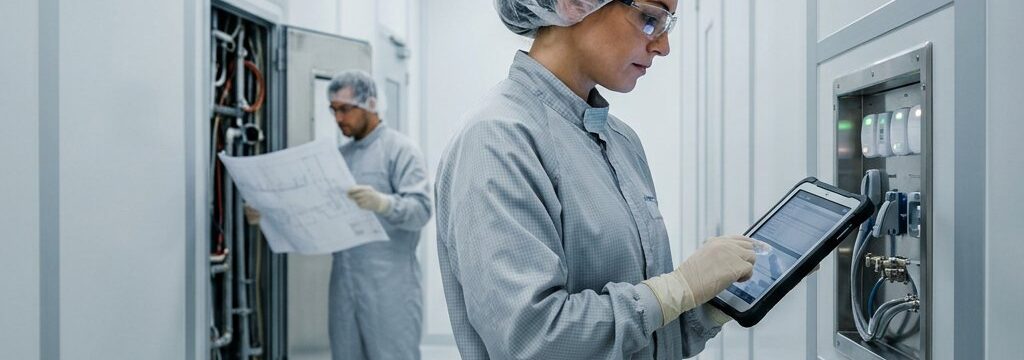
Change control voor cleanrooms: risico’s en aanpak

Even a small change can push a cleanroom out of control without being noticed. An extra machine, different occupancy, new packaging material, an adjusted cleaning regime or work on the air handling can lead to a higher particle or microbiological load, disrupted pressure differentials or deviations in temperature and relative humidity.
Table of Contents
- 1Which changes affect the state of control?
- 2Which points should always be included in an impact assessment?
- 3A practical change control procedure in 7 steps
- 4Four common changes and their cleanroom impact
- 5When are requalification and document updates needed?
- 6Mistakes that cause unnecessary audit findings
- Show more...
Key takeaways
- Assess planned changes up front with a structured impact assessment on particles, microbiology and critical cleanroom parameters.
- Look broadly: HVAC/utilities, equipment, layout, materials, procedures and occupancy all influence the state of control.
- Follow a 7-step change control procedure from description and risk classification to controlled implementation and verification.
- Requalification and document updates are required when airflow, filters, pressure hierarchy, layout, utilities or room use are affected.
- Avoid pitfalls: implementing without formal approval, focusing only on process, not collecting evidence/trends and failing to update documentation.
That is why change control is more than a form. It is the fixed route in which you assess the impact in advance, record appropriate control measures, formally approve the change, implement it in a controlled way and afterwards demonstrate with evidence that the room is still suitable for its intended use.
Below you will find a practical framework with assessment points, examples and clear signals for when additional monitoring, document updates or requalification are needed.
Which changes affect the state of control?
In a cleanroom, change is unavoidable, but the impact often only becomes visible after trends have already deteriorated. Change control should prevent rising particle or microbiological burden, disturbed airflow, pressure cascade problems or deviations in temperature and humidity from only being noticed when product quality or process stability are already under pressure.
Contamination control is not only about cleaning afterwards. It is about controlling sources, routes and build-up of contamination. Think of physical changes such as equipment, filters, layout or materials, but also operational changes such as extra operators, adjusted gowning, different cleaning agents, changed workflow or different material flows.
Which points should always be included in an impact assessment?
An impact assessment is the documented assessment of the effect of a planned change on particle load, microbiological load and critical cleanroom parameters. If your requirements are not yet well defined, see How to write a cleanroom URS.
| Assessment point | What do you record? | Risk and required control |
|---|---|---|
| Utilities and HVAC | Change in airflow volume, setpoints, pressure, temperature or RH | Risk of loss of pressure cascade or class; verify with measurements, alarm checks and trend review |
| Gases and water | Type of supply, connection point, quality and consumption | Risk of quality or availability problems; support with specifications and test where needed |
| Equipment and vibration | Dimensions, mass, heat output, movement and emissions | Risk of particle generation, resonance or process disruption; assess under operating conditions |
| ESD and electromagnetic interference | New sources, susceptibility and earthing | Risk of product or process disruptions; check with technical verification |
| Lighting and heat load | Additional luminaires, heat sources or changed occupancy heat load | Risk of local heating and deviations in conditions; assess with temperature and RH data |
| Chemical emissions | New materials, adhesives, cleaners or disinfectants | Risk of residue, outgassing or material incompatibility; assess suitability in advance |
| Airflow patterns and layout | Position of objects, barriers, height and walking routes | Risk of dead zones or turbulence; demonstrate with airflow and particle checks |
| Operational procedures | Changes in gowning, cleaning, routing or maintenance | Risk of human-introduced contamination; ensure through procedure update and training |
| Materials and packaging | Composition, cleanability, fibre shedding and transfer method | Fibre-shedding, moisture-retaining or difficult-to-clean materials such as cardboard are generally unsuitable |
A practical change control procedure in 7 steps
In regulated environments, the GMP Annex 1 guidance on change control makes a change control procedure for the cleanroom the formal route for assessing, approving, implementing and verifying a change with quality, cleanroom or GxP impact.
- Describe the change exactly. Record the starting situation and the situation after implementation, including the room involved, equipment, people, planning, downtime and the temporary situation during installation or maintenance.
- Classify the impact. Determine early whether the change has a low, medium or high risk for classification, process, hygiene, safety, monitoring or release.
- Carry out a traceable risk assessment. For each effect, link the possible failure mechanism to the parameter that is affected, such as pressure, particles, microbiology or temperature.
- Translate risk into control measures. Think of additional cleaning, containment, shielding, separate routing, training, temporary occupancy limits, additional monitoring as outlined in Setting up a cleanroom monitoring plan or operational restrictions.
- Record approvals and implementation conditions in advance. Determine who must approve, under which conditions the change may take place and which release criteria apply.
- Implement in a controlled way. Carry out the change according to plan, with clear responsibilities, deviation recording and control of the temporary situation.
- Verify and only close after evidence according to Cleanroom validation steps and requalification. Review measurement results, trends, inspections and document updates, and only resume routine use when operation is demonstrably under control.
Four common changes and their cleanroom impact
| Change | Typical cleanroom impact | What is often needed |
|---|---|---|
| More operators | Higher human contamination load and more air disturbance due to movement | Review occupancy limits, retraining and extra trend or environmental monitoring |
| New equipment | Additional vibration, heat, turbulence or its own particle generation | Assessment under operating conditions and review of position in the layout |
| Different disinfectant | Changed residue formation, contact time, material compatibility and efficacy against flora | Advance substantiation, safety assessment and procedure update |
| HEPA replacement or HVAC work | Risk of released contamination, pressure instability and start-up problems | Containment, deep cleaning, integrity test, flushing and particle checks |
When are requalification and document updates needed?
Partial or full requalification comes into view as soon as a change directly affects airflow, filters, pressure hierarchy, layout, utilities or the way the room is used. The stricter the environment, the smaller the margin for error within the ISO 14644-2 validation requirements. An ISO 4 cleanroom is, according to ISO 14644-1, a very strictly classified room; tolerance for additional particles or disturbed airflow patterns is minimal there.
Alongside technical verification, documents often also need to change: the contamination control plan, monitoring plan, cleaning and disinfection procedures, behaviour and clothing, material transfer via airlock or pass box and maintenance and inspection instructions. Release after the change should be linked to evidence from trends, alarms, deviations and verification tests. Cleanroom Systems International B.V. supports this type of process with the design, engineering, construction and maintenance of modular cleanrooms, but the change may only be closed once the room is demonstrably back under control.
Mistakes that cause unnecessary audit findings
- Implementing a change without prior assessment and formal approval.
- Looking only at process or product impact and leaving the cleanroom impact on air, pressure, behaviour and material flows out of sight.
- Not collecting evidence after implementation through trends, measurements, inspections or verification tests.
- Not updating procedures, monitoring, training or contamination control documentation, making later deviations difficult to trace.
Frequently asked questions
Related articles
Cleanroom interlock: operation, types and design considerations
A cleanroom interlock prevents…
Material Transfer in Aseptic Cleanrooms
Material and equipment transfe…
Cleanroom smoke study
A smoke study makes airflow vi…
