


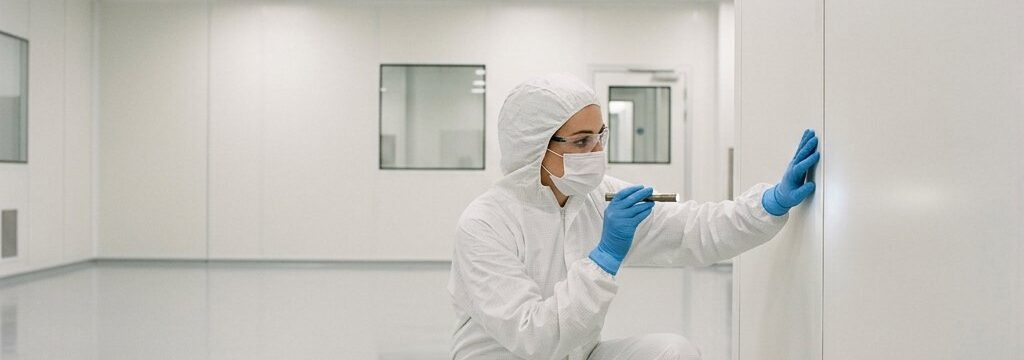
What is a cleanroom?

A cleanroom is a controlled environment in which the concentration of airborne particles is actively kept low. Depending on the application, microbiological contamination or vapours also matter. The difference from a room that is merely clean is fundamental: filtration, airflow, pressure, temperature and humidity are deliberately designed, monitored and controlled.
Table of Contents
- 1How can you recognise a true cleanroom?
- 2How does a cleanroom keep contamination under control?
- 3Which ISO and GMP requirements apply?
- 3.1ISO classes at a glance
- 3.2What ISO 7 requires in practice
- 3.3When GMP imposes additional requirements
- 4In which sectors are cleanrooms indispensable?
- 5What does the design and construction of a cleanroom require?
- 5.1Materials and finishes must remain cleanable
- 5.2Air handling, pressure hierarchy and airlocks determine performance
- 6Why human behaviour, clothing and cleaning matter so much
- 6.1Behaviour and clothing limit human contamination
- 6.2Cleaning is done by protocol, not by sight
- 7What determines the cost of a cleanroom?
- 8Frequently asked questions about cleanrooms
- Show more...
Key takeaways
- Cleanrooms control particles (and where required microbes or vapours) via filtration, defined airflow, pressure, temperature and humidity.
- ISO 14644-1 classifies by measurable airborne particles; GMP adds procedures, training, cleaning, documentation and traceability.
- Design starts from process risk and flows; room concept, materials and air handling underpin performance.
- People, gowning, access control and protocolled cleaning are decisive; monitor and validate to sustain class.
- Costs depend on class, size and air system, finishes/integration, airlocks/monitoring/validation and operating expenses.
This becomes necessary as soon as contamination directly affects product quality, process stability or safety. Think of pharmaceutical manufacturing, medical applications, food, semiconductor and mechatronics. In all these environments, "clean" must not just look clean, but remain demonstrably under control.
How can you recognise a true cleanroom?
A true cleanroom is designed to control contamination, not just to look tidy. Particle load is actively limited through technology, access discipline and fixed working procedures.
That is why controlled air cleanliness, defined airflow, pressure control, stable temperature and humidity are all part of it. Limited access, suitable materials and clear rules of use are also part of the concept. The goal is always the same: to protect the product, the process and, in some applications, the user or patient as well.
How does a cleanroom keep contamination under control?
A cleanroom keeps contamination under control by continuously supplying filtered air in a directed flow and removing contamination before particles can settle. This usually involves HEPA filtration and, where the application requires it, even finer filtration.
In addition, pressure differentials and airlock functions keep contamination out and help separate zones from each other. Temperature, humidity and pressure are monitored because fluctuations affect the product and the process. The biggest disturbances often come from the air and from people, so technology and behaviour must work together.
Which ISO and GMP requirements apply?
For the classification of cleanrooms, the starting point is usually ISO 14644-1 standards and classification. This standard classifies rooms based on the maximum permitted number of airborne particles at defined particle sizes. The lower the ISO class, the stricter the air quality requirements.
In regulated environments, GMP may apply on top of this. Then it is not only about the room itself, but also about procedures, training, documentation, cleaning and traceability. Which class is appropriate follows from process risk, product sensitivity and critical operations, so there is no universal class that is right for every cleanroom. For practical selection guidance, see Which ISO or GMP class does your cleanroom need?.
ISO classes at a glance
The overview below shows the relative strictness. The exact limit values depend on the measured particle size and the measurement conditions, but classification is always about measurable air quality and not visual cleanliness.
| ISO class | Relative particle limit | Practical meaning |
|---|---|---|
| ISO 8 | Highest permitted particle load in this overview | Filtered air and clear basic discipline required |
| ISO 7 | Stricter than ISO 8 | More control over airflow, routes and use |
| ISO 6 | Clearly lower particle limits | More intensive filtration and tighter process control |
| ISO 5 | Very low permitted particle load | High performance level for systems, monitoring and discipline |
What ISO 7 requires in practice
- Filtered air, a suitable air-change concept and demonstrable particle control within ISO 7 limits.
- Control of clothing, material transfer, surfaces, cleaning and movement routes so that use does not compromise the class.
- Periodic measurements and validation to document that the room also remains within specification during operation.
When GMP imposes additional requirements
Where GMP applies, the focus shifts from measurement alone to full assurance. Then training, release, cleaning protocols, records, deviation management and traceability also count. ISO classification describes the technical state of the room; GMP ensures that people, processes and documentation also maintain that state.
In which sectors are cleanrooms indispensable?
- Pharmaceutical and medical: contamination control to support product and patient safety.
- Food: hygienic process conditions, good cleanability and controllable zones.
- Semiconductor: very low particle load for sensitive wafers, components and processes.
- Mechatronics and high-tech assembly: stable conditions for precise production and testing.
- Research and laboratories: matched pressure hierarchy, air handling and appropriate user protection.
- The right approach differs by process; class, routing, material choice and monitoring are never the same everywhere.
What does the design and construction of a cleanroom require?
The design of a cleanroom begins with the question of what happens in the room: which process steps are critical, which ISO class is needed, and how do people, materials and waste streams move through the building? Only then do structural and building services choices follow. If you are mapping out your project planning, see How long does it take to build a cleanroom?.
Those choices determine how cleanable, maintainable and expandable the room is in practice. Walls, ceilings, floors, doors, windows, junction details, changing rooms and airlock functions must support contamination risk control. In turnkey projects such as those delivered by Cleanroom Systems International, access for maintenance, validation and future modifications is also considered early in the design. A key early decision is the room concept; compare the main types in Softwall vs hardwall cleanroom.
Materials and finishes must remain cleanable
Materials and finishes in a cleanroom must be smooth, sealed and wear-resistant, so that they can be cleaned frequently without releasing additional particles. Open joints, porous surfaces and transitions that are difficult to reach do the opposite and act as dust traps.
That is why chemical resistance, cleanability and durability weigh heavily in the choice of floor, wall and ceiling. A neat finish is not only aesthetic, but a direct part of contamination control.
Air handling, pressure hierarchy and airlocks determine performance
The performance of a cleanroom stands or falls with its air handling system. Filtration, air changes and the chosen airflow together form the technical basis for the required ISO class.
On top of that, pressure differentials and ventilation in cleanrooms ensure that air moves in the right direction between zones. Personnel and material airlocks help separate flows and limit cross-contamination. Stable temperature and humidity are also essential because they support process reliability and reproducibility.
Why human behaviour, clothing and cleaning matter so much
Even the best designed cleanroom loses performance if its use is not assured. In many situations, people are one of the biggest sources of particles, which means presence, movement and working practices directly affect the measured air quality.
That is why cleanroom clothing and behaviour, gowning procedures, access control and cleaning protocols are part of the basis of contamination control. The right cleaning frequency depends on the class, the process and the critical surfaces. Training, inspection, maintenance and periodic checks are needed to maintain performance and correct deviations in time.
Behaviour and clothing limit human contamination
- Correct cleanroom clothing limits particles from skin, hair and ordinary clothing.
- Changing rooms and fixed gowning sequences separate dirty and clean zones; where needed, additional barriers are used.
- Only authorised persons are given access, and unnecessary movement or extra occupancy in critical rooms is avoided.
- Personal items and brought-in tools must also fit the zone requirements and be introduced in a controlled way.
Cleaning is done by protocol, not by sight
Cleanrooms are not cleaned based on what looks visibly dirty, but according to a fixed protocol. A room that looks clean can still be out of specification because of too many particles on critical surfaces or in the air.
That is why frequency, sequence, materials and records are laid down. What is appropriate depends on the ISO class, the demands of the process, the nature of contact surfaces and, where relevant, GMP requirements. Work with approved low-linting materials, clear walking and cleaning routes, and complete records of execution, measurements and deviations. This makes cleaning part of process control instead of a separate facilities task.
What determines the cost of a cleanroom?
On the question of What does it cost to build a cleanroom?, a price per m² says little without a clear scope. The total investment and operating costs usually depend on:
- the cleanroom class, size and desired air handling system;
- finishes, utilities and integration with process equipment;
- changing rooms, airlocks, monitoring, documentation and validation;
- operating costs for cleaning, personnel, maintenance, measurements and any downtime.
Frequently asked questions about cleanrooms
In addition to standards, design and use, there are often a few orientation questions as well. Below we answer two frequently searched questions briefly and factually, so that you can more quickly determine which expertise and functions belong with a cleanroom environment.
Frequently asked questions
What is a cleanroom company?
A cleanroom company specialises in controlled environments. Such a provider translates process risks into requirements for air systems, routing, finishes, cleanability and use. Unlike a general contractor, a specialist works from the standpoint of contamination control. The scope differs by provider: from advice on your cleanroom project and design to construction, modification, validation coordination, service or inspection.
What is the salary of a cleanroom operator?
There is no fixed figure for that. The salary of a cleanroom operator depends mainly on the sector, shift work, education, experience and responsibilities. A role in pharmaceutical manufacturing, food or high-tech can therefore differ significantly. Collective agreements, region and employer also ultimately determine the range.
Related articles
Cleanroom interlock: operation, types and design considerations
A cleanroom interlock prevents…
Material Transfer in Aseptic Cleanrooms
Material and equipment transfe…
Cleanroom smoke study
A smoke study makes airflow vi…
