


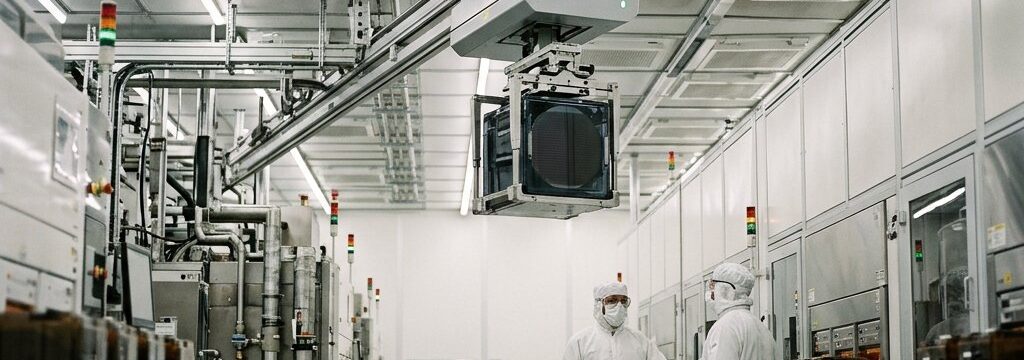
AMHS in semiconductor cleanrooms

In a semiconductor cleanroom, an Automated Material Handling System (AMHS) is more than internal transport. Routes between stockers, load ports and tools directly affect the layout, air balance, contamination control and the risk of particle deposition in wafer production. That is why AMHS needs to be included as early as the concept and URS phase: trying to fit it in later often causes routing conflicts, extra validation and disruption to production. Below, you can read about the key design choices, control measures, test steps and cost factors for new build and retrofit.
Table of Contents
- 1Why material transport also helps determine cleanroom performance
- 2Which design requirements AMHS places on the cleanroom
- 3How to control contamination, process zones and traceability
- 4What AMHS means for operators, maintenance and safe working
- 5Which tests and releases are needed before go-live
- 6Which factors determine the investment in AMHS integration
- 7New build or retrofit: when a cleanroom specialist makes the difference
- Show more...
Key takeaways
- Include AMHS from the concept and URS phase to avoid routing conflicts, extra validation and production disruption.
- AMHS impacts airflows, FFU layout, pressure hierarchy, zoning and the required cleanroom classifications.
- Control contamination and compatibility via zoning, admission rules and traceable carrier status, cleaning and changeovers.
- Treat AMHS as a validated operating condition; test interlocks, interfaces, route changes and recovery under representative loads.
- Investment drivers include transport/control complexity, cleanroom and facilities adaptations, validation effort and tougher phasing in retrofits; early involvement of a cleanroom specialist improves outcomes.
Why material transport also helps determine cleanroom performance
AMHS does more than drive throughput. It also determines how many manual transfers remain necessary in critical zones. Product mix, material history and route choices affect contamination risk and process compatibility. Therefore, AMHS should be included from the first cleanroom concept in classification, zoning and equipment interfaces, in line with the Semiconductor cleanroom design criteria, and not only after the tool layout has been fixed.
Which design requirements AMHS places on the cleanroom
| Design aspect | Impact of AMHS |
|---|---|
| Airflows and FFU layout | Rails, stockers and interfaces must not disrupt unidirectional air or cause turbulence. |
| Pressure hierarchy and return air | Openings and movements must fit within the pressure cascade and keep the air balance stable. |
| Routing and maintenance | Ceiling and service zones require support structure, clear height and safe maintenance access. For guidance on when a walkable ceiling supports OHT rails and service access, see Walkable cleanroom ceiling – when it’s the right choice. |
| Classification and zones | The required ISO class may differ by process area and interface; a single overall class does not provide enough detail. |
| Utilities and process alignment | Exhaust, special gases, wet and dry processes must align spatially and technically. |
How to control contamination, process zones and traceability
- Use admission rules for each carrier, material and process step.
- Separate sensitive, wet-chemical and emission-intensive processes into dedicated AMHS zones and routes.
- Record carrier status, such as clean, released, quarantined or rejected.
- Document cleaning, release, changeovers and exceptions with full traceability.
- Cleanroom classification alone does not prove compatibility between materials.
For controlled transfer points that complement AMHS routes, see Use of pass box and material gate in cleanrooms.
What AMHS means for operators, maintenance and safe working
Less manual transport reduces operator workload and limits traffic in critical zones, but safe working still depends on gowning, intervention procedures, machine guarding and good ESD control in cleanrooms. Maintenance and faults require fixed access routes, clean/dirty separation and a controlled recovery procedure. A clear division of roles between production, facilities, maintenance and integration partners prevents uncontrolled restart and contamination.
Which tests and releases are needed before go-live
- Treat AMHS as a validated operating condition, not only as mechanical installation or a software link.
- Test interlocks, route changes and load and unload interfaces under representative operating conditions.
- Check particle levels, Pressure difference and ventilation in cleanrooms, and the air balance after interventions and changeovers.
- Practise representative maintenance return-to-service scenarios and environmental recovery before release.
- Record acceptance criteria, test results and release limits in the handover documentation.
Which factors determine the investment in AMHS integration
| Factor | Effect on the investment |
|---|---|
| Transport system and control | Routing complexity, stockers, load ports and software links determine a large part of the base investment. |
| Cleanroom and facilities | Class, ceiling load, utilities, exhaust and interface modifications increase the technical scope. |
| Validation and documentation | Verification, release and dossier preparation must be included from the start. |
| Retrofit | Phasing, temporary provisions, limited space and business continuity often make existing situations more expensive. |
New build or retrofit: when a cleanroom specialist makes the difference
With AMHS integration, process, building, cleanroom envelope, building services and equipment converge in a single design decision. In existing buildings, the structure, ceiling height, routing and working alongside ongoing production are often decisive. A cleanroom specialist translates these requirements into classification, layout, interfaces, construction phasing and demonstrable handover. For projects where construction, validation coordination and maintenance also need to align, an integrated party such as Cleanroom Systems International, with experience from the Nearfield Instruments cleanroom project and other Semiconductor projects, often works more efficiently.
Frequently asked questions
Related articles
Cleanroom interlock: operation, types and design considerations
A cleanroom interlock prevents…
Material Transfer in Aseptic Cleanrooms
Material and equipment transfe…
Cleanroom smoke study
A smoke study makes airflow vi…
