


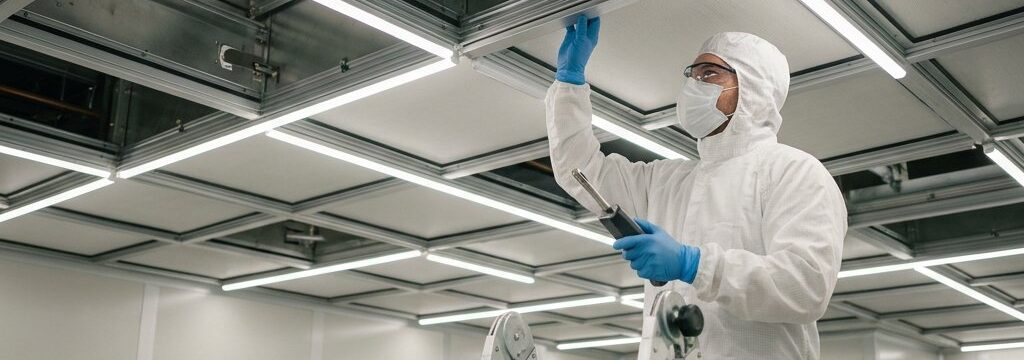
HEPA vs ULPA filters for cleanrooms

ULPA filters capture even finer particles than HEPA filters, but that higher level of filtration almost always comes with greater pressure drop and therefore more demanding requirements for the air handling system. The best choice is therefore not automatically the highest efficiency on paper. For a good cleanroom design, the required class, the process risk, the required airflow rate and the energy consumption also matter. It is important to be clear from the outset: both HEPA and ULPA are intended for particle filtration. Different filter technologies are needed for gases, vapours and odours.
Table of Contents
Key takeaways
- ULPA filters finer than HEPA but increases pressure drop and HVAC demands.
- Assess filters by MPPS-tested performance (EN 1822) and process risk, not just the biggest efficiency figure.
- HEPA (H13–H14) suits many cleanroom applications; ULPA (U15–U17) is for highly critical zones.
- Higher classes affect airflow, fan capacity, energy use and often the required filter area.
- Service life and maintenance should follow load, pressure monitoring and integrity testing rather than the calendar.
What 99.97% and 99.999% mean in technical terms
HEPA and ULPA filters are high-efficiency filters made of fine fibre media that remove airborne particles. This does not happen through a single mechanism, but through a combination of interception, impaction and diffusion. Larger particles are more likely to be removed from the airstream because, due to their mass or trajectory, they do not move neatly around the fibres. Very small particles, by contrast, show more random movement, causing them to collide with fibres and remain trapped.
In practice, you often see reference values such as HEPA at around 99.97% at 0.3 µm and ULPA at around 99.999% at 0.12 µm or 0.1 µm. ULPA achieves this with a denser filter structure. That stated particle size is not a hard lower limit, but a test or reference point around the so-called MPPS: the most penetrating particle size at which the filter is relatively least efficient. For both larger and smaller particles, capture can in fact be higher. Both filter types are therefore intended for fine particulate matter and other particles, not for odour, gas or vapour. To assess whether the selected filter grade meets particle limits in practice, see Particle measurement in cleanrooms.
HEPA and ULPA side by side: classes and specifications
Under EN 1822, HEPA and ULPA filters are classified according to their performance at the MPPS. In data sheets, you often see efficiency or penetration; they are the inverse of one another.
| Class | Type | Efficiency at MPPS | Max. penetration |
|---|---|---|---|
| H13 | HEPA | ≥ 99.95% | ≤ 0.05% |
| H14 | HEPA | ≥ 99.995% | ≤ 0.005% |
| U15 | ULPA | ≥ 99.9995% | ≤ 0.0005% |
| U16 | ULPA | ≥ 99.99995% | ≤ 0.00005% |
| U17 | ULPA | ≥ 99.999995% | ≤ 0.000005% |
H13 and H14 are both HEPA, but H14 allows a maximum of ten times fewer particles to pass than H13. They are therefore not automatically interchangeable. In US documentation, "HEPA" is sometimes used more broadly, so always check the exact class and test basis.
The impact on pressure drop, airflow rate and energy consumption
Pressure drop is the resistance a filter causes in the airflow. The denser the filter media, the harder the fan must work to deliver the same airflow rate. Because ULPA filters more finely, that resistance is generally higher than with HEPA. This has a direct effect on fan capacity, required filter area and the ability to achieve the desired number of air changes or the required air volume flow rate.
In many applications, HEPA therefore offers the more practical balance between particle control and system performance. ULPA may be technically necessary, but it more quickly creates additional load on HVAC, higher energy consumption and sometimes larger or modified filter ceilings as well. Especially when adapting existing cleanrooms, the available system capacity is often a hard constraint.
Which filter suits your cleanroom and process?
The right filter choice follows from the ISO 14644-1 cleanroom classification and the actual contamination risk of the process, not only from the highest efficiency figure. A HEPA filter is therefore not automatically always necessary, and a ULPA filter certainly is not. In many pharmaceutical, medical, food and general manufacturing environments, a well-designed HEPA solution is often the logical choice, because it combines stable particle control with a workable airflow rate and manageable system load.
ULPA mainly comes into the picture in semiconductor, microelectronics and similarly critical processes, where stricter particle limits or smaller critical particles apply. The final choice must align with the complete cleanroom: classification according to the relevant standard, Pressure difference and ventilation in cleanrooms, layout, airtightness and validation requirements (see ISO 14644-2 validation requirements). That is why Cleanroom Systems International does not look only at filter class in the design, but at the performance of the entire controlled environment.
Costs, service life and maintenance in practice
- Total costs: HEPA is usually more cost-effective to purchase. ULPA is generally more expensive because of the finer construction and because of higher requirements for fans, filter area and energy consumption.
- Service life: in practice, ULPA can clog more quickly under the same particle load. As a result, inspection and replacement are often needed sooner than in a comparable HEPA application.
- Replacement timing: do not replace solely by calendar date. Pre-filtration, operating hours, contamination level and measured pressure drop together determine the right interval.
- Maintenance: a HEPA filter in a critical cleanroom is normally not a component you clean yourself. Inspection, a HEPA filter integrity testing and replacement belong in a maintenance and validation plan according to the requirements of your process and room. For broader upkeep planning, see Cleanroom maintenance and inspection.
Frequently asked questions
Related articles
Cleanroom interlock: operation, types and design considerations
A cleanroom interlock prevents…
Material Transfer in Aseptic Cleanrooms
Material and equipment transfe…
Cleanroom smoke study
A smoke study makes airflow vi…
